

Anne, Katherine, and the Court That Watched Them Burn
At the glittering center of Henry VIII’s court, velvet gowns rustled, whispers stirred the air, and hearts beat with ambition, devotion—and dread.
Anne Boleyn, sharp of wit and shrouded in mystery, had once walked behind Queen Katherine of Aragon as her lady-in-waiting. She held the queen’s train. She offered prayers at her side. She stood in the background, dutiful and observant. But Anne was never going to stay in the background for long.
A Crown Divided
Henry’s obsession with Anne did not blossom in secrecy—it unfolded in full view of the court. While Katherine continued to move through palace halls with grace and dignity, her husband paraded his affection for Anne with increasing boldness. Public glances turned to private letters. And eventually, everyone at court knew: the King was no longer in love with his Queen.
To Katherine, Anne was never more than a distraction. A flirt. A plaything that would pass, like so many of Henry’s dalliances before. She remained steadfast, believing Henry would come back to her, that the woman who waited on her could never truly replace her.
But Anne wasn’t just being courted. She was being positioned.
The Woman Who Waited
Anne’s time as a lady-in-waiting gave her more than a front-row seat to power—it gave her the script. She knew how to maneuver, when to flatter, and when to withhold. She refused to become Henry’s mistress. If he wanted her, it would be as Queen. And for Henry, used to women bending easily to his whims, this resistance was intoxicating.
Meanwhile, Queen Katherine stood on sinking ground. Her position was slipping, but her dignity remained unshaken. She refused to grant a divorce. She would not step aside. She was the daughter of Isabella of Castile, a queen in her own right. And she would not be cast aside for a girl with ambition and a French hood.
A Court Full of Tension
The tension at court was suffocating. Courtiers had to choose sides. Conversations became political traps. Every look, every seat at dinner, every favor granted or denied carried hidden meaning.
Behind fans and tapestries, ladies whispered about Henry’s affections. Behind closed doors, clergymen and advisors debated the legality of a marriage to Anne. And in the heart of it all, Anne and Katherine coexisted—two women tethered by circumstance, separated by desire, and unwilling to yield.
Not Just a Love Triangle
This was more than a love triangle. It was a seismic shift in the monarchy, in religion, in gender and power. Anne’s rise led to England’s break from Rome. It led to Katherine’s banishment, and the eventual birth of Elizabeth I. It led to triumph, tragedy—and the echo of a woman’s laughter turning to silence in the Tower.
Anne may have waited on Katherine. But she didn’t wait quietly.
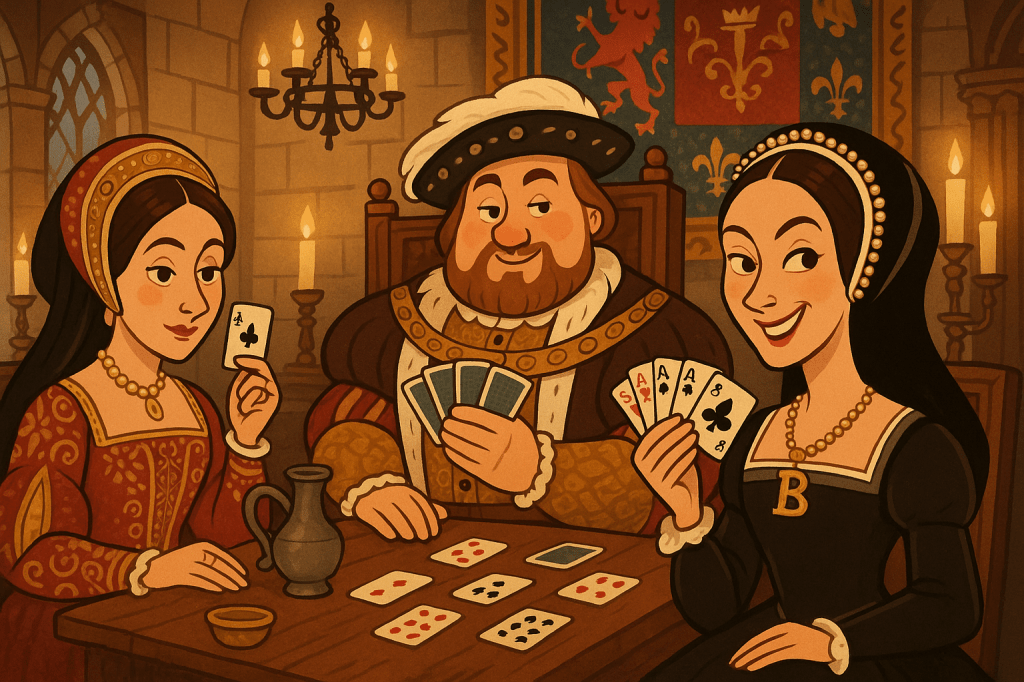
It’s easy to reduce this chapter of history to villain versus victim. But the truth, as always, is knotted and complicated. Katherine held on when the world wanted her to let go. Anne reached for a crown in a world that told her she shouldn’t. And Henry? He loved, lost, and ultimately broke everything to have what he wanted.
In the end, the crown wasn’t just on the head—it was in the heart.


 crownedandcurious.blog